Quick answer
Prepare a French CA3 VAT return from a controlled transaction map, not a single sales total. Separate French taxable sales, reverse charges, intra-Community transactions, imports, deductible VAT, credits and corrections; then reconcile each category to invoices, ledgers, marketplace reports, stock movements and customs records. On the 2026 form, lines 19, 20 and 24 cover distinct deductible-VAT categories, while lines 25 to 27 manage the resulting credit. Foreign businesses generally file by the 19th of the following month or quarter, but import VAT declarants have a 24th deadline. File and pay online through EFI or EDI, including a nil return when the applicable regime requires one.
What a French CA3 VAT return does
Form 3310-CA3-SD is the periodic return for businesses under the French normal or mini-real VAT regime. It records taxable bases, gross VAT, deductible VAT, adjustments and the net amount due or credit for the period. The 2026 form is number 10963*31 and its notice is number 50449#29. The notice expressly covers foreign businesses carrying out taxable transactions in France.
A French VAT number does not tell you which transactions belong on the return. Start with the exact legal entity and the period, then determine which supplies, acquisitions, imports and deductions are French. Our French VAT return service turns that classification into workpapers, a reviewed CA3 and a filing evidence pack.
Use the live DGFiP form and notice for the filing year. Line labels and administrative practice can change, so a spreadsheet designed for a previous form should be checked before it is reused.
Build the French CA3 VAT return from a transaction map
Lock the source-data cut-off and preserve the original files. Create separate schedules for French domestic sales, exports, intra-Community supplies and acquisitions, imports, purchases subject to reverse charge, deductible purchases, capital goods, credit notes and prior-period corrections. Every schedule should identify the invoice or customs entry, tax point, taxable base, VAT rate, VAT amount and evidence reference.
Do not net unlike transactions. A refund is not simply negative current turnover if it corrects an earlier period; import VAT is not ordinary supplier VAT; and marketplace-collected VAT is not automatically the seller's output VAT. Classification comes before line mapping.
Reconcile the transaction schedules back to the general ledger, sales platform, purchase ledger, bank and inventory system. The final bridge should explain every difference between source totals and the return, including rounding and manual adjustments.
French CA3 VAT return lines on the 2026 form
The following map groups the lines most likely to matter to a cross-border business. It is a preparation aid, not a universal instruction: the transaction facts and the current notice determine the correct treatment.
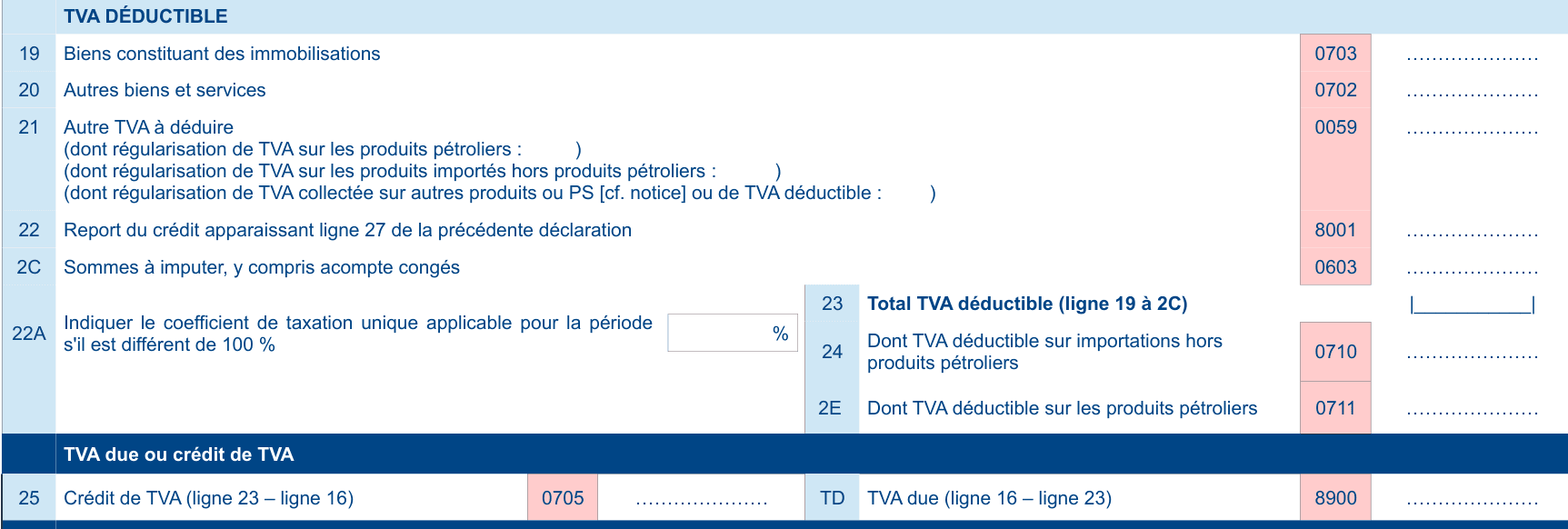
- 19Deductible VAT on capital goods
- 20Deductible VAT on other goods and services
- 21Other VAT to deduct, including specified adjustments
- 22Credit carried forward from line 27 of the previous return
- 23Total deductible VAT, lines 19 to 2C
- 24Of which deductible import VAT, non-petroleum
- 25VAT credit, line 23 minus line 16
- TDVAT due, line 16 minus line 23
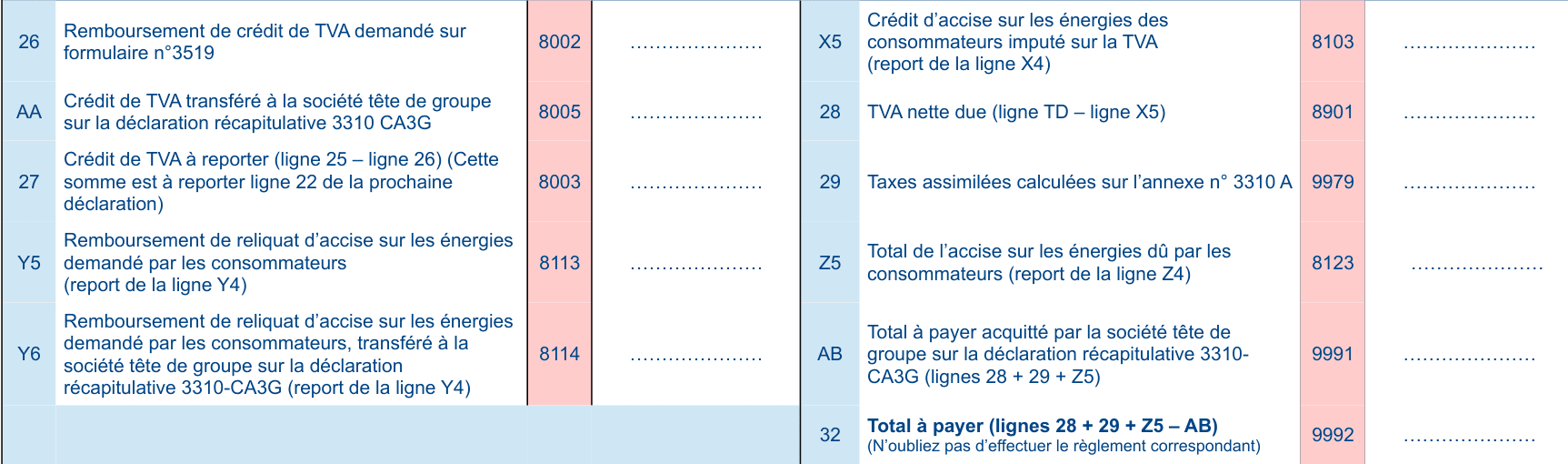
- 26Refund of the credit requested on form 3519
- 27Credit carried forward to line 22 of the next return
- 28Net VAT due, line TD minus line X5
- 32Total payable, including the assimilated taxes
| Transaction or balance | 2026 CA3 area | Control before filing |
|---|---|---|
| French taxable sales | A1 for current taxable turnover, A2 for specified other taxable transactions, then the applicable rate lines such as 08, 09 or 9B. | Tax point, French place of supply, taxable base, rate and credit notes. |
| Reverse-charge purchases | A3 for certain cross-border services and B4 for specified purchases from a supplier not established in France; gross VAT then feeds the relevant rate lines. | Supplier status, customer liability, invoice wording and corresponding deduction rights. |
| Intra-Community transactions | B2 for acquisitions; F2 for exempt intra-Community supplies; line 17 identifies gross VAT on acquisitions. | Valid VAT numbers, dispatch or arrival evidence, recapitulative data and period alignment. |
| Imports into France | A4 and I1 to I6 report the import base and gross import VAT by rate; line 24 reports deductible non-petroleum import VAT. | Importer identity, customs declaration, ATVAI data, value, rate and separate right-to-deduct evidence. |
| Ordinary deductible VAT | Line 19 for capital goods, line 20 for other goods and services, line 21 for specified adjustments, and line 22 for the prior CA3 credit. | Valid invoice, business use, deduction date, exclusions and agreement to the purchase ledger. |
| VAT credit | Line 25 shows the credit; line 26 is the refund requested under the applicable conditions and line 27 is carried forward to line 22 of the next return. | Prior credit roll-forward, form 3519 where required, refund eligibility and bank details. |
| VAT payable | TD calculates VAT due, line 28 gives net VAT due after applicable adjustments and line 32 gives the total payable including relevant assimilated taxes. | Approval, online payment mandate, bank availability and payment reference. |
Always check the current form and notice. A line number is not a tax analysis, and a prefilled amount is not automatically correct.
Reconcile the records before approving the CA3
Sales should reconcile to invoices, order data, refunds and the general ledger. Purchases should reconcile to valid supplier invoices and the deduction schedule. Intra-EU transactions need VAT-number and movement evidence. Imports need customs entries and ATVAI detail. Stock transfers need inventory and transport records even when no customer invoice exists.
Keep a correction register. For every credit note or prior-period adjustment, record the original period, reason, supporting document, CA3 line, sign, amount and reviewer. This prevents the same correction from being taken twice or silently disappearing from the audit trail.
A reviewable return has a two-way bridge: every CA3 amount can be traced to a schedule, and every in-scope schedule amount can be traced to a CA3 line or a documented exclusion.
Separate marketplace VAT from the seller's own CA3
Marketplace reports are evidence, not the legal return. A platform may be deemed supplier and collect VAT on selected sales, while the seller still reports imports, stock movements, direct sales, B2B transactions or other flows. Do not assume that a marketplace's tax column is either entirely included or entirely excluded.
Reconcile by transaction ID and legal role. Identify the seller of record, dispatch country, arrival country, customer status, marketplace VAT treatment and the entity that imported or owned the stock. The guide on marketplace-collected VAT and seller registrations explains why platform collection does not remove every French filing obligation.
French CA3 VAT return deadlines for foreign companies
The deadline is not the same in every situation. DGFiP's foreign-business guidance gives the 19th for the SIEE monthly and quarterly regimes. French Customs gives the 24th for all import VAT declarants. Use the deadline shown in the professional tax account or assigned by the authority where it differs, and schedule internal approval before that date.
| Situation | Official filing date | Practical control |
|---|---|---|
| Monthly real regime | Generally the 19th of the following month for a non-established business managed by SIEE. | The CA3 is normally available online from the first day of the due month. |
| Quarterly real regime | Generally the 19th after the quarter; the option is associated with annual VAT due below EUR 4,000. | Do not infer quarterly status from low sales; confirm the assigned regime. |
| Seasonal activity | The 19th of the month after a taxable operation under the SIEE guidance. | The official foreign-business page says no nil CA3 is required for inactive seasonal periods. |
| Entity liable for import VAT | The 24th of each month according to French Customs. | Review the customs prefill available from the 14th and resolve differences before filing. |
A weekend or public holiday can affect the operational due date. The date assigned in the taxpayer account and current authority guidance control the filing.
File a nil CA3 when the regime requires it
No sales does not always mean no return. DGFiP states that monthly and quarterly foreign businesses submit a nil return when they have no taxable operation for the period. Before marking a period nil, check imports, intra-EU acquisitions, reverse-charge purchases, stock movements, deductible invoices and corrections as well as sales.
Seasonal taxpayers are treated differently under the published foreign-business guidance: they file after a taxable operation and do not submit nil returns for inactive periods. Confirm that the entity is actually registered as seasonal rather than applying the exception informally.
Submit and pay the CA3 through EFI or EDI
Foreign businesses file and pay electronically. EFI means using the professional account directly; EDI means transmitting through an authorised EDI partner. The route should be configured before the deadline, with the correct access rights, bank account and SEPA B2B mandate where required.
Approval should cover both the return and the payment. Record the approved amount, filing operator, filing timestamp, acknowledgement, payment order and bank debit. If the CA3 produces a credit, record whether it is carried forward on line 27 or a refund is requested on line 26 with the required form and evidence.
Submission is not the end of the period file
Keep the filed CA3, acknowledgement, payment or credit status, source schedules, adjustments and reviewer approval together. That is the evidence needed to explain the return later.
Example: a German seller with French imports and sales
A German company imports goods in its own name into France, holds them in a French warehouse and sells to French consumers. It also receives one French supplier invoice and issues a credit note correcting the previous month's sale. The company has no French fixed establishment and files monthly through SIEE.
The preparer keeps imports separate from domestic sales. Customs bases and gross import VAT are reconciled to ATVAI and mapped to A4 and I1 to I6; the supported deductible import VAT goes to line 24. French sales feed A1 and the applicable rate line. The supplier invoice is reviewed for line 20. The credit note is recorded as a visible correction rather than being hidden in current sales.
Because the company is an import VAT declarant, the team uses the 24th deadline rather than the general SIEE 19th. It checks the customs prefill after the 14th, approves the return and payment, files through the selected electronic route and retains the complete evidence pack. This is an illustration, not a client case or a treatment for every seller.
Final CA3 review checklist
Complete the review before the internal approval cut-off. An unexplained difference should be resolved or documented; it should not be forced into a convenient line to make the ledger balance.
Changing provider between two periods? The provider handover checklist tracks who files the changeover period and where a carried-forward credit goes.
- Confirm the legal entity, French VAT number, regime, period and assigned deadline.
- Preserve original source files and document the cut-off.
- Classify sales, purchases, intra-EU flows, imports, stock movements and corrections separately.
- Reconcile every schedule to ledgers, invoices, platforms, customs and inventory records.
- Check line 19, line 20 and line 24 separately; do not combine unlike deduction categories.
- Roll line 27 forward to line 22 of the next CA3 when a credit is carried forward.
- Confirm whether the 19th or import-VAT 24th deadline applies.
- Approve filing and payment or credit treatment together.
- Save the filed return, acknowledgement, bank evidence, workpapers and adjustment register.
Official sources
Last reviewed 11 August 2026. Rules and operational procedures can change, so confirm the current position for your exact products and sales flows.
- DGFiP: 2026 CA3 form and notice
- DGFiP: 2026 CA3 form 3310-CA3-SD
- DGFiP: 2026 CA3 notice 3310-NOT-CA3-SD
- DGFiP: French VAT rules for foreign businesses
- DGFiP: when a CA3 becomes available online
- DGFiP: online filing and payment for foreign businesses
- French Customs: import VAT self-assessment on the CA3
- BOFiP: deduction of French import VAT